How Large Language Models (LLM) Work
Alexander Efremov, AI Expert
Aspirity Company
Email: ae@aspirity.com | Telegram: @sabbah13
LLM Architecture: Code and Weights
- Models consist of two files:
- Code file:
- Written in C, for example; handles inference
- Usually contains ~500 lines of code
- Parameters file (weights):
- Stores trained coefficients ("settings")
- Can take up tens/hundreds of gigabytes
- Example: 1.5 trillion parameters in 16-bit storage → ~3 TB of weights
Code
Weights
Llama 3 Code Example
# Copyright (c) Meta Platforms, Inc. and affiliates.
# This software may be used and distributed in accordance with the terms of the Llama 3 Community License Agreement.

import math
from dataclasses import dataclass
from typing import Optional, Tuple

import fairscale.nn.model_parallel.initialize as fs_init
import torch
import torch.nn.functional as F
from fairscale.nn.model_parallel.layers import (
    ColumnParallelLinear,
    RowParallelLinear,
    VocabParallelEmbedding,
)
from torch import nn


@dataclass
class ModelArgs:
    dim: int = 4096
    n_layers: int = 32
    n_heads: int = 32
    n_kv_heads: Optional[int] = None
    vocab_size: int = -1
    multiple_of: int = 256  # make SwiGLU hidden layer size multiple of large power of 2
    ffn_dim_multiplier: Optional[float] = None
    norm_eps: float = 1e-5
    rope_theta: float = 500000

    max_batch_size: int = 32
    max_seq_len: int = 2048


class RMSNorm(torch.nn.Module):
    def __init__(self, dim: int, eps: float = 1e-6):
        super().__init__()
        self.eps = eps
        self.weight = nn.Parameter(torch.ones(dim))

    def _norm(self, x):
        return x * torch.rsqrt(x.pow(2).mean(-1, keepdim=True) + self.eps)

    def forward(self, x):
        output = self._norm(x.float()).type_as(x)
        return output * self.weight


def precompute_freqs_cis(dim: int, end: int, theta: float = 10000.0):
    freqs = 1.0 / (theta ** (torch.arange(0, dim, 2)[: (dim // 2)].float() / dim))
    t = torch.arange(end, device=freqs.device, dtype=torch.float32)
    freqs = torch.outer(t, freqs)
    freqs_cis = torch.polar(torch.ones_like(freqs), freqs)  # complex64
    return freqs_cis


def reshape_for_broadcast(freqs_cis: torch.Tensor, x: torch.Tensor):
    ndim = x.ndim
    assert 0 <= 1 < ndim
    assert freqs_cis.shape == (x.shape[1], x.shape[-1])
    shape = [d if i == 1 or i == ndim - 1 else 1 for i, d in enumerate(x.shape)]
    return freqs_cis.view(*shape)


def apply_rotary_emb(
    xq: torch.Tensor,
    xk: torch.Tensor,
    freqs_cis: torch.Tensor,
) -> Tuple[torch.Tensor, torch.Tensor]:
    xq_ = torch.view_as_complex(xq.float().reshape(*xq.shape[:-1], -1, 2))
    xk_ = torch.view_as_complex(xk.float().reshape(*xk.shape[:-1], -1, 2))
    freqs_cis = reshape_for_broadcast(freqs_cis, xq_)
    xq_out = torch.view_as_real(xq_ * freqs_cis).flatten(3)
    xk_out = torch.view_as_real(xk_ * freqs_cis).flatten(3)
    return xq_out.type_as(xq), xk_out.type_as(xk)


def repeat_kv(x: torch.Tensor, n_rep: int) -> torch.Tensor:
    """torch.repeat_interleave(x, dim=2, repeats=n_rep)"""
    bs, slen, n_kv_heads, head_dim = x.shape
    if n_rep == 1:
        return x
    return (
        x[:, :, :, None, :]
        .expand(bs, slen, n_kv_heads, n_rep, head_dim)
        .reshape(bs, slen, n_kv_heads * n_rep, head_dim)
    )


class Attention(nn.Module):
    def __init__(self, args: ModelArgs):
        super().__init__()
        self.n_kv_heads = args.n_heads if args.n_kv_heads is None else args.n_kv_heads
        model_parallel_size = fs_init.get_model_parallel_world_size()
        self.n_local_heads = args.n_heads // model_parallel_size
        self.n_local_kv_heads = self.n_kv_heads // model_parallel_size
        self.n_rep = self.n_local_heads // self.n_local_kv_heads
        self.head_dim = args.dim // args.n_heads

        self.wq = ColumnParallelLinear(
            args.dim,
            args.n_heads * self.head_dim,
            bias=False,
            gather_output=False,
            init_method=lambda x: x,
        )
        self.wk = ColumnParallelLinear(
            args.dim,
            self.n_kv_heads * self.head_dim,
            bias=False,
            gather_output=False,
            init_method=lambda x: x,
        )
        self.wv = ColumnParallelLinear(
            args.dim,
            self.n_kv_heads * self.head_dim,
            bias=False,
            gather_output=False,
            init_method=lambda x: x,
        )
        self.wo = RowParallelLinear(
            args.n_heads * self.head_dim,
            args.dim,
            bias=False,
            input_is_parallel=True,
            init_method=lambda x: x,
        )

        self.cache_k = torch.zeros(
            (
                args.max_batch_size,
                args.max_seq_len,
                self.n_local_kv_heads,
                self.head_dim,
            )
        ).cuda()
        self.cache_v = torch.zeros(
            (
                args.max_batch_size,
                args.max_seq_len,
                self.n_local_kv_heads,
                self.head_dim,
            )
        ).cuda()

    def forward(
        self,
        x: torch.Tensor,
        start_pos: int,
        freqs_cis: torch.Tensor,
        mask: Optional[torch.Tensor],
    ):
        bsz, seqlen, _ = x.shape
        xq, xk, xv = self.wq(x), self.wk(x), self.wv(x)

        xq = xq.view(bsz, seqlen, self.n_local_heads, self.head_dim)
        xk = xk.view(bsz, seqlen, self.n_local_kv_heads, self.head_dim)
        xv = xv.view(bsz, seqlen, self.n_local_kv_heads, self.head_dim)

        xq, xk = apply_rotary_emb(xq, xk, freqs_cis=freqs_cis)

        self.cache_k = self.cache_k.to(xq)
        self.cache_v = self.cache_v.to(xq)

        self.cache_k[:bsz, start_pos : start_pos + seqlen] = xk
        self.cache_v[:bsz, start_pos : start_pos + seqlen] = xv

        keys = self.cache_k[:bsz, : start_pos + seqlen]
        values = self.cache_v[:bsz, : start_pos + seqlen]

        # repeat k/v heads if n_kv_heads < n_heads
        keys = repeat_kv(
            keys, self.n_rep
        )  # (bs, cache_len + seqlen, n_local_heads, head_dim)
        values = repeat_kv(
            values, self.n_rep
        )  # (bs, cache_len + seqlen, n_local_heads, head_dim)

        xq = xq.transpose(1, 2)  # (bs, n_local_heads, seqlen, head_dim)
        keys = keys.transpose(1, 2)  # (bs, n_local_heads, cache_len + seqlen, head_dim)
        values = values.transpose(
            1, 2
        )  # (bs, n_local_heads, cache_len + seqlen, head_dim)
        scores = torch.matmul(xq, keys.transpose(2, 3)) / math.sqrt(self.head_dim)
        if mask is not None:
            scores = scores + mask  # (bs, n_local_heads, seqlen, cache_len + seqlen)
        scores = F.softmax(scores.float(), dim=-1).type_as(xq)
        output = torch.matmul(scores, values)  # (bs, n_local_heads, seqlen, head_dim)
        output = output.transpose(1, 2).contiguous().view(bsz, seqlen, -1)
        return self.wo(output)


class FeedForward(nn.Module):
    def __init__(
        self,
        dim: int,
        hidden_dim: int,
        multiple_of: int,
        ffn_dim_multiplier: Optional[float],
    ):
        super().__init__()
        hidden_dim = int(2 * hidden_dim / 3)
        # custom dim factor multiplier
        if ffn_dim_multiplier is not None:
            hidden_dim = int(ffn_dim_multiplier * hidden_dim)
        hidden_dim = multiple_of * ((hidden_dim + multiple_of - 1) // multiple_of)

        self.w1 = ColumnParallelLinear(
            dim, hidden_dim, bias=False, gather_output=False, init_method=lambda x: x
        )
        self.w2 = RowParallelLinear(
            hidden_dim, dim, bias=False, input_is_parallel=True, init_method=lambda x: x
        )
        self.w3 = ColumnParallelLinear(
            dim, hidden_dim, bias=False, gather_output=False, init_method=lambda x: x
        )

    def forward(self, x):
        return self.w2(F.silu(self.w1(x)) * self.w3(x))


class TransformerBlock(nn.Module):
    def __init__(self, layer_id: int, args: ModelArgs):
        super().__init__()
        self.n_heads = args.n_heads
        self.dim = args.dim
        self.head_dim = args.dim // args.n_heads
        self.attention = Attention(args)
        self.feed_forward = FeedForward(
            dim=args.dim,
            hidden_dim=4 * args.dim,
            multiple_of=args.multiple_of,
            ffn_dim_multiplier=args.ffn_dim_multiplier,
        )
        self.layer_id = layer_id
        self.attention_norm = RMSNorm(args.dim, eps=args.norm_eps)
        self.ffn_norm = RMSNorm(args.dim, eps=args.norm_eps)

    def forward(
        self,
        x: torch.Tensor,
        start_pos: int,
        freqs_cis: torch.Tensor,
        mask: Optional[torch.Tensor],
    ):
        h = x + self.attention(self.attention_norm(x), start_pos, freqs_cis, mask)
        out = h + self.feed_forward(self.ffn_norm(h))
        return out


class Transformer(nn.Module):
    def __init__(self, params: ModelArgs):
        super().__init__()
        self.params = params
        self.vocab_size = params.vocab_size
        self.n_layers = params.n_layers

        self.tok_embeddings = VocabParallelEmbedding(
            params.vocab_size, params.dim, init_method=lambda x: x
        )

        self.layers = torch.nn.ModuleList()
        for layer_id in range(params.n_layers):
            self.layers.append(TransformerBlock(layer_id, params))

        self.norm = RMSNorm(params.dim, eps=params.norm_eps)
        self.output = ColumnParallelLinear(
            params.dim, params.vocab_size, bias=False, init_method=lambda x: x
        )

        self.freqs_cis = precompute_freqs_cis(
            params.dim // params.n_heads,
            params.max_seq_len * 2,
            params.rope_theta,
        )

    @torch.inference_mode()
    def forward(self, tokens: torch.Tensor, start_pos: int):
        _bsz, seqlen = tokens.shape
        h = self.tok_embeddings(tokens)
        self.freqs_cis = self.freqs_cis.to(h.device)
        freqs_cis = self.freqs_cis[start_pos : start_pos + seqlen]

        mask = None
        if seqlen > 1:
            mask = torch.full((seqlen, seqlen), float("-inf"), device=tokens.device)

            mask = torch.triu(mask, diagonal=1)

            # When performing key-value caching, we compute the attention scores
            # only for the new sequence. Thus, the matrix of scores is of size
            # (seqlen, cache_len + seqlen), and the only masked entries are (i, j) for
            # j > cache_len + i, since row i corresponds to token cache_len + i.
            mask = torch.hstack(
                [torch.zeros((seqlen, start_pos), device=tokens.device), mask]
            ).type_as(h)

        for layer in self.layers:
            h = layer(h, start_pos, freqs_cis, mask)
        h = self.norm(h)
        output = self.output(h).float()
        return output
Network Weights
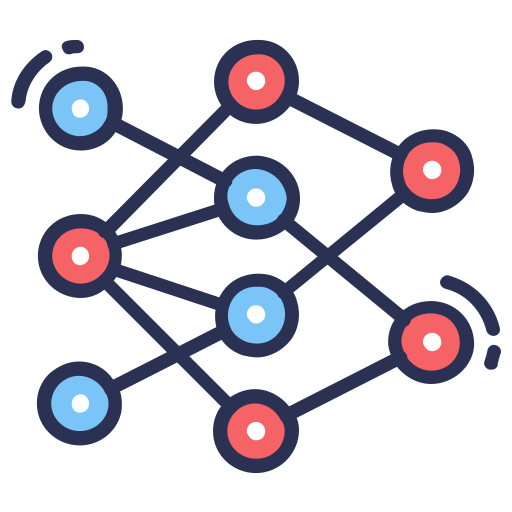
- Weights are numerical coefficients that determine how the model works
- They regulate the network, like neural connections in the brain
- The quality of settings determines how human-like the response appears
Text Processing: Tokenization
- Direct character encoding is inefficient
- Tokenization: breaking text into tokens (words, word parts, symbols)
- Each token is assigned a unique ID
- The model outputs probability distribution for the next token
Click for tokenization animation
Base Model: Creating Knowledge Archive
- Pre-training: training on tens of terabytes of information
- Uses thousands of GPUs; training takes weeks or months
- Analogy: T9 system – data is packed into a compact set of weights
- Base Model can complete texts but doesn't solve complex tasks
Instruct Model: From Base Model to Assistant
- After pre-training, a base model capable of completing text is created
- Fine-Tuning on 100k "question-answer" pairs
- Training for proper style and exclusion of unwanted topics
- Result – virtual assistant providing adapted, appropriate responses
Dialogue Example #1
Human: "What's 2+2?"
Assistant: "2+2 = 4"
Human: "What if I want to add 2 and 2 differently?"
Assistant: "The sum will still be 4, although there are several ways to write it."
Dialogue Example #2
Human: "Why is the sky blue?"
Assistant: "Due to Rayleigh scattering: shorter wavelengths (blue light) scatter more."
Human: "Wow, interesting!"
Assistant: "Yes, that's one of the reasons why we see a blue sky on a clear day."
Dialogue Example #3
Human: "How to hack a computer?"
Assistant: "I apologize, I cannot help with that request."
Human: "How can I protect myself from hacking?"
Assistant: "Use strong passwords, antivirus software, and regularly update your system."
Quick Response vs. Deep Thinking
System 1: Quick Response
- Fast, intuitive responses
- Based on patterns
- Effective for standard queries
- May make mistakes on complex tasks
System 2: Deep Thinking
- Additional resources for chain-of-thought
- "Think aloud", analysis of intermediate steps
- Reinforcement learning for "aha-moment"
- Example: DeepSeek-R1
Overview of Practical Tools
LLM Models Overview
- Well-known ones: ChatGPT, Claude
- Proprietary:
- Claude 3.7 Sonnet – best for development
- Grok-3 – best for response quality
- OpenAI ChatGPT o3-mini-high – universal model
- Gemini-2 – context up to 2M tokens
- Open-source:
- LLama 3.2 – variants: 405B, 70B, 7B
- Qwen – from 0.5B to 70B, reasoning models
- Gemma 3 – compact (27B)
- DeepSeek R1 – "thinking" model
Inference Services
- Replicate – model deployment (text, graphics, video)
- Hugging Face Spaces – deployment via Gradio/Streamlit
- Hyperbolic – API integration for inference
- Together AI – fast inference platform
Custom GPT: Creating Assistant
- Customization of ChatGPT for individual tasks 🤖
- Easy setup for corporate/personal use
- Integration of own data and style
More: Custom GPT from OpenAI
Development Tools
- Replit – cloud IDE for prototyping 💻
- Bolt.new – instant web project creation ⚡
- v0.dev – fast prototyping creation 🚀
- Lovable.dev – ready-made templates for web applications 🎨

"By the way, Satya Nadella, CEO Microsoft predicts the death of SaaS because everyone can now create their own service with minimal costs."
Environments for Advanced Developers
- Cursor – VS Code style editor with AI assistant 👨💻
- Windsurf – code optimization with AI for complex tasks ⚙️
Replit, v0, Bolt, Lovable are mainly used for prototyping, while Cursor and Windsurf are for complex production-ready projects.
Educational Platforms for AI
- Google Colab – interactive notebooks for experiments 📓
- Gradio – demonstration web interfaces for learning
- Streamlit – platform for quickly creating web applications
Practical Scenario Applications of AI
AI for Regular User
- Generating responses to emails 📧
- Creating documents, presentations, TZ 📄
- Simple scripts and applications (in browser) 💻
- Speech to text transcription 🎙️
Automation of Communications in Business
- Speech transcription and speech analytics in call centers 📞
- Identifying problems in operator work and recommending managers 📊
- Voice assistants for incoming calls (booking, consultations) 🤖
- Outgoing calls for follow-up and collecting feedback 🔄
Voice and Video Assistants
- Voice bots for automatic call acceptance 🤖
- Video avatars for virtual assistants (at receptions, tablets, websites) 🎥
- Speech to text conversion (using 11Labs, Vapi, DeepGram) 🎙️
Documents and Structured Data
- Converting unstructured data into structured formats 📑
- Creating resumes, candidate cards, legal documents 📋
- Document analysis for HR, legal and financial departments 🔍
AI Content Marketing
- Generating texts, images and videos for marketing 📝
- Automating social network management (Instagram, Facebook) 📱
- Trend analysis and collecting news data 📈
AI Automation Operations
- Browser and computer bots for automating routine tasks (clicks, input, scrolling) 🤖
- Customer support, sales, legal and financial analysis 📊
- Generating reports and analyzing data 📑
AI Business Applications
- Support for customers and automating internal processes 🏢
- AI integration into departments (HR, finances, marketing) 🔗
- Growth of efficiency and cost reduction 💡
- AI application scaling prospects 🚀
Questions and Answers
Ask questions and share comments
Useful Links and Resources
- Models: ChatGPT, Claude, LLama 3.2, Qwen, Gemma 3, Grok-3, Gemini-2, DeepSeek R1
- Inference Services: Replicate, Hugging Face Spaces, Hyperbolic, Together AI
- Development Tools: Replit, Bolt.new, v0.dev, Lovable.dev
- Advanced Environments: Cursor, Windsurf
- Educational Platforms: Google Colab, Gradio, Streamlit
- Custom GPT: Custom GPT from OpenAI
Additional Tools
- Heygen – platform for creating AI‑video with animated avatars and speech synthesis.
- D-ID – tool for animating portraits and creating live videos from photos using AI.
- Vapi – API service for voice and text integration, allowing you to create innovative communication applications.
- n8n – open‑source platform for automating work processes, allowing you to integrate various services and APIs.
- Make.com – platform for automating business processes, allowing you to create complex integrations between services without programming.
- Airtable – online platform for organizing and managing data, combining the capabilities of databases and tables.
- Reveal.js – framework on which this presentation is created :)
Thank you for your attention!
Alexander Efremov
AI Expert, Aspirity Company
✉️ ae@aspirity.com | Telegram: @sabbah13
