Cómo Funcionan los Modelos de Lenguaje Grande (LLM)
Alexander Efremov, Experto en IA
Compañía Aspirity
Email: ae@aspirity.com | Telegram: @sabbah13
Arquitectura LLM: Código y Pesos
- Los modelos consisten en dos archivos:
- Archivo de código:
- Escrito en C, por ejemplo; maneja la inferencia
- Generalmente contiene ~500 líneas de código
- Archivo de parámetros (pesos):
- Almacena coeficientes entrenados ("configuraciones")
- Puede ocupar decenas/cientos de gigabytes
- Ejemplo: 1.5 billones de parámetros en almacenamiento de 16 bits → ~3 TB de pesos
Código
Pesos
Ejemplo de Código Llama 3
# Copyright (c) Meta Platforms, Inc. and affiliates.
# This software may be used and distributed in accordance with the terms of the Llama 3 Community License Agreement.

import math
from dataclasses import dataclass
from typing import Optional, Tuple

import fairscale.nn.model_parallel.initialize as fs_init
import torch
import torch.nn.functional as F
from fairscale.nn.model_parallel.layers import (
    ColumnParallelLinear,
    RowParallelLinear,
    VocabParallelEmbedding,
)
from torch import nn


@dataclass
class ModelArgs:
    dim: int = 4096
    n_layers: int = 32
    n_heads: int = 32
    n_kv_heads: Optional[int] = None
    vocab_size: int = -1
    multiple_of: int = 256  # make SwiGLU hidden layer size multiple of large power of 2
    ffn_dim_multiplier: Optional[float] = None
    norm_eps: float = 1e-5
    rope_theta: float = 500000

    max_batch_size: int = 32
    max_seq_len: int = 2048


class RMSNorm(torch.nn.Module):
    def __init__(self, dim: int, eps: float = 1e-6):
        super().__init__()
        self.eps = eps
        self.weight = nn.Parameter(torch.ones(dim))

    def _norm(self, x):
        return x * torch.rsqrt(x.pow(2).mean(-1, keepdim=True) + self.eps)

    def forward(self, x):
        output = self._norm(x.float()).type_as(x)
        return output * self.weight


def precompute_freqs_cis(dim: int, end: int, theta: float = 10000.0):
    freqs = 1.0 / (theta ** (torch.arange(0, dim, 2)[: (dim // 2)].float() / dim))
    t = torch.arange(end, device=freqs.device, dtype=torch.float32)
    freqs = torch.outer(t, freqs)
    freqs_cis = torch.polar(torch.ones_like(freqs), freqs)  # complex64
    return freqs_cis


def reshape_for_broadcast(freqs_cis: torch.Tensor, x: torch.Tensor):
    ndim = x.ndim
    assert 0 <= 1 < ndim
    assert freqs_cis.shape == (x.shape[1], x.shape[-1])
    shape = [d if i == 1 or i == ndim - 1 else 1 for i, d in enumerate(x.shape)]
    return freqs_cis.view(*shape)


def apply_rotary_emb(
    xq: torch.Tensor,
    xk: torch.Tensor,
    freqs_cis: torch.Tensor,
) -> Tuple[torch.Tensor, torch.Tensor]:
    xq_ = torch.view_as_complex(xq.float().reshape(*xq.shape[:-1], -1, 2))
    xk_ = torch.view_as_complex(xk.float().reshape(*xk.shape[:-1], -1, 2))
    freqs_cis = reshape_for_broadcast(freqs_cis, xq_)
    xq_out = torch.view_as_real(xq_ * freqs_cis).flatten(3)
    xk_out = torch.view_as_real(xk_ * freqs_cis).flatten(3)
    return xq_out.type_as(xq), xk_out.type_as(xk)


def repeat_kv(x: torch.Tensor, n_rep: int) -> torch.Tensor:
    """torch.repeat_interleave(x, dim=2, repeats=n_rep)"""
    bs, slen, n_kv_heads, head_dim = x.shape
    if n_rep == 1:
        return x
    return (
        x[:, :, :, None, :]
        .expand(bs, slen, n_kv_heads, n_rep, head_dim)
        .reshape(bs, slen, n_kv_heads * n_rep, head_dim)
    )


class Attention(nn.Module):
    def __init__(self, args: ModelArgs):
        super().__init__()
        self.n_kv_heads = args.n_heads if args.n_kv_heads is None else args.n_kv_heads
        model_parallel_size = fs_init.get_model_parallel_world_size()
        self.n_local_heads = args.n_heads // model_parallel_size
        self.n_local_kv_heads = self.n_kv_heads // model_parallel_size
        self.n_rep = self.n_local_heads // self.n_local_kv_heads
        self.head_dim = args.dim // args.n_heads

        self.wq = ColumnParallelLinear(
            args.dim,
            args.n_heads * self.head_dim,
            bias=False,
            gather_output=False,
            init_method=lambda x: x,
        )
        self.wk = ColumnParallelLinear(
            args.dim,
            self.n_kv_heads * self.head_dim,
            bias=False,
            gather_output=False,
            init_method=lambda x: x,
        )
        self.wv = ColumnParallelLinear(
            args.dim,
            self.n_kv_heads * self.head_dim,
            bias=False,
            gather_output=False,
            init_method=lambda x: x,
        )
        self.wo = RowParallelLinear(
            args.n_heads * self.head_dim,
            args.dim,
            bias=False,
            input_is_parallel=True,
            init_method=lambda x: x,
        )

        self.cache_k = torch.zeros(
            (
                args.max_batch_size,
                args.max_seq_len,
                self.n_local_kv_heads,
                self.head_dim,
            )
        ).cuda()
        self.cache_v = torch.zeros(
            (
                args.max_batch_size,
                args.max_seq_len,
                self.n_local_kv_heads,
                self.head_dim,
            )
        ).cuda()

    def forward(
        self,
        x: torch.Tensor,
        start_pos: int,
        freqs_cis: torch.Tensor,
        mask: Optional[torch.Tensor],
    ):
        bsz, seqlen, _ = x.shape
        xq, xk, xv = self.wq(x), self.wk(x), self.wv(x)

        xq = xq.view(bsz, seqlen, self.n_local_heads, self.head_dim)
        xk = xk.view(bsz, seqlen, self.n_local_kv_heads, self.head_dim)
        xv = xv.view(bsz, seqlen, self.n_local_kv_heads, self.head_dim)

        xq, xk = apply_rotary_emb(xq, xk, freqs_cis=freqs_cis)

        self.cache_k = self.cache_k.to(xq)
        self.cache_v = self.cache_v.to(xq)

        self.cache_k[:bsz, start_pos : start_pos + seqlen] = xk
        self.cache_v[:bsz, start_pos : start_pos + seqlen] = xv

        keys = self.cache_k[:bsz, : start_pos + seqlen]
        values = self.cache_v[:bsz, : start_pos + seqlen]

        # repeat k/v heads if n_kv_heads < n_heads
        keys = repeat_kv(
            keys, self.n_rep
        )  # (bs, cache_len + seqlen, n_local_heads, head_dim)
        values = repeat_kv(
            values, self.n_rep
        )  # (bs, cache_len + seqlen, n_local_heads, head_dim)

        xq = xq.transpose(1, 2)  # (bs, n_local_heads, seqlen, head_dim)
        keys = keys.transpose(1, 2)  # (bs, n_local_heads, cache_len + seqlen, head_dim)
        values = values.transpose(
            1, 2
        )  # (bs, n_local_heads, cache_len + seqlen, head_dim)
        scores = torch.matmul(xq, keys.transpose(2, 3)) / math.sqrt(self.head_dim)
        if mask is not None:
            scores = scores + mask  # (bs, n_local_heads, seqlen, cache_len + seqlen)
        scores = F.softmax(scores.float(), dim=-1).type_as(xq)
        output = torch.matmul(scores, values)  # (bs, n_local_heads, seqlen, head_dim)
        output = output.transpose(1, 2).contiguous().view(bsz, seqlen, -1)
        return self.wo(output)


class FeedForward(nn.Module):
    def __init__(
        self,
        dim: int,
        hidden_dim: int,
        multiple_of: int,
        ffn_dim_multiplier: Optional[float],
    ):
        super().__init__()
        hidden_dim = int(2 * hidden_dim / 3)
        # custom dim factor multiplier
        if ffn_dim_multiplier is not None:
            hidden_dim = int(ffn_dim_multiplier * hidden_dim)
        hidden_dim = multiple_of * ((hidden_dim + multiple_of - 1) // multiple_of)

        self.w1 = ColumnParallelLinear(
            dim, hidden_dim, bias=False, gather_output=False, init_method=lambda x: x
        )
        self.w2 = RowParallelLinear(
            hidden_dim, dim, bias=False, input_is_parallel=True, init_method=lambda x: x
        )
        self.w3 = ColumnParallelLinear(
            dim, hidden_dim, bias=False, gather_output=False, init_method=lambda x: x
        )

    def forward(self, x):
        return self.w2(F.silu(self.w1(x)) * self.w3(x))


class TransformerBlock(nn.Module):
    def __init__(self, layer_id: int, args: ModelArgs):
        super().__init__()
        self.n_heads = args.n_heads
        self.dim = args.dim
        self.head_dim = args.dim // args.n_heads
        self.attention = Attention(args)
        self.feed_forward = FeedForward(
            dim=args.dim,
            hidden_dim=4 * args.dim,
            multiple_of=args.multiple_of,
            ffn_dim_multiplier=args.ffn_dim_multiplier,
        )
        self.layer_id = layer_id
        self.attention_norm = RMSNorm(args.dim, eps=args.norm_eps)
        self.ffn_norm = RMSNorm(args.dim, eps=args.norm_eps)

    def forward(
        self,
        x: torch.Tensor,
        start_pos: int,
        freqs_cis: torch.Tensor,
        mask: Optional[torch.Tensor],
    ):
        h = x + self.attention(self.attention_norm(x), start_pos, freqs_cis, mask)
        out = h + self.feed_forward(self.ffn_norm(h))
        return out


class Transformer(nn.Module):
    def __init__(self, params: ModelArgs):
        super().__init__()
        self.params = params
        self.vocab_size = params.vocab_size
        self.n_layers = params.n_layers

        self.tok_embeddings = VocabParallelEmbedding(
            params.vocab_size, params.dim, init_method=lambda x: x
        )

        self.layers = torch.nn.ModuleList()
        for layer_id in range(params.n_layers):
            self.layers.append(TransformerBlock(layer_id, params))

        self.norm = RMSNorm(params.dim, eps=params.norm_eps)
        self.output = ColumnParallelLinear(
            params.dim, params.vocab_size, bias=False, init_method=lambda x: x
        )

        self.freqs_cis = precompute_freqs_cis(
            params.dim // params.n_heads,
            params.max_seq_len * 2,
            params.rope_theta,
        )

    @torch.inference_mode()
    def forward(self, tokens: torch.Tensor, start_pos: int):
        _bsz, seqlen = tokens.shape
        h = self.tok_embeddings(tokens)
        self.freqs_cis = self.freqs_cis.to(h.device)
        freqs_cis = self.freqs_cis[start_pos : start_pos + seqlen]

        mask = None
        if seqlen > 1:
            mask = torch.full((seqlen, seqlen), float("-inf"), device=tokens.device)

            mask = torch.triu(mask, diagonal=1)

            # When performing key-value caching, we compute the attention scores
            # only for the new sequence. Thus, the matrix of scores is of size
            # (seqlen, cache_len + seqlen), and the only masked entries are (i, j) for
            # j > cache_len + i, since row i corresponds to token cache_len + i.
            mask = torch.hstack(
                [torch.zeros((seqlen, start_pos), device=tokens.device), mask]
            ).type_as(h)

        for layer in self.layers:
            h = layer(h, start_pos, freqs_cis, mask)
        h = self.norm(h)
        output = self.output(h).float()
        return output
Pesos de la Red
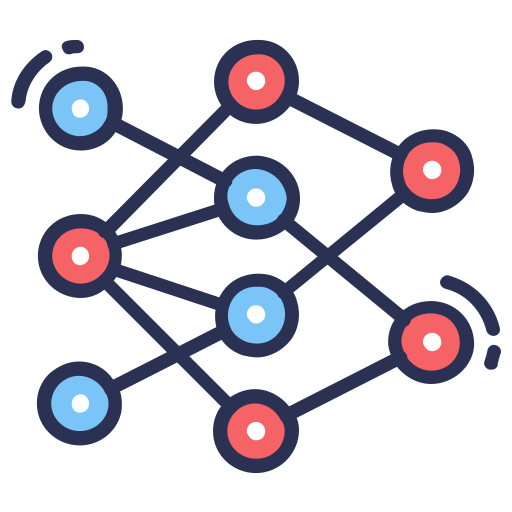
- Los pesos son coeficientes numéricos que determinan cómo funciona el modelo
- Regulan la red, como las conexiones neuronales en el cerebro
- La calidad de la configuración determina qué tan humana parece la respuesta
Procesamiento de Texto: Tokenización
- La codificación directa de caracteres es ineficiente
- Tokenización: dividir el texto en tokens (palabras, partes de palabras, símbolos)
- A cada token se le asigna un ID único
- El modelo genera una distribución de probabilidad para el siguiente token
Haz clic para ver la animación de tokenización
Modelo Base: Creando el Archivo de Conocimiento
- Pre-entrenamiento: entrenamiento en decenas de terabytes de información
- Utiliza miles de GPUs; el entrenamiento toma semanas o meses
- Analogía: sistema T9 – los datos se empaquetan en un conjunto compacto de pesos
- El Modelo Base puede completar textos pero no resuelve tareas complejas
Modelo Instruct: Del Modelo Base al Asistente
- Después del pre-entrenamiento, se crea un modelo base capaz de completar texto
- Ajuste fino (Fine-Tuning) en 100 mil pares de "pregunta-respuesta"
- Entrenamiento para el estilo adecuado y exclusión de temas no deseados
- Resultado – asistente virtual que proporciona respuestas adaptadas y apropiadas
Ejemplo de Diálogo #1
Humano: "¿Cuánto es 2+2?"
Asistente: "2+2 = 4"
Humano: "¿Y si quiero sumar 2 y 2 de otra manera?"
Asistente: "La suma seguirá siendo 4, aunque hay varias formas de escribirlo."
Ejemplo de Diálogo #2
Humano: "¿Por qué el cielo es azul?"
Asistente: "Debido a la dispersión de Rayleigh: las longitudes de onda más cortas (luz azul) se dispersan más."
Humano: "¡Vaya, interesante!"
Asistente: "Sí, esa es una de las razones por las que vemos un cielo azul en un día despejado."
Ejemplo de Diálogo #3
Humano: "¿Cómo hackear una computadora?"
Asistente: "Lo siento, no puedo ayudar con esa solicitud."
Humano: "¿Cómo puedo protegerme del hackeo?"
Asistente: "Use contraseñas fuertes, software antivirus y actualice regularmente su sistema."
Respuesta Rápida vs. Pensamiento Profundo
Sistema 1: Respuesta Rápida
- Respuestas rápidas e intuitivas
- Basadas en patrones
- Efectivas para consultas estándar
- Pueden cometer errores en tareas complejas
Sistema 2: Pensamiento Profundo
- Recursos adicionales para cadena de pensamiento
- "Piensa en voz alta", análisis de pasos intermedios
- Aprendizaje por refuerzo para el "momento eureka"
- Ejemplo: DeepSeek-R1
Visión General de Herramientas Prácticas
Visión General de Modelos LLM
- Los más conocidos: ChatGPT, Claude
- Propietarios:
- Claude 3.7 Sonnet – mejor para desarrollo
- Grok-3 – mejor en calidad de respuestas
- OpenAI ChatGPT o3-mini-high – modelo universal
- Gemini-2 – contexto hasta 2M tokens
- Código abierto:
- LLama 3.2 – variantes: 405B, 70B, 7B
- Qwen – desde 0.5B hasta 70B, modelos de razonamiento
- Gemma 3 – compacto (27B)
- DeepSeek R1 – modelo "pensante"
Servicios de Inferencia
- Replicate – implementación de modelos (texto, gráficos, video)
- Hugging Face Spaces – implementación vía Gradio/Streamlit
- Hyperbolic – integración API para inferencia
- Together AI – plataforma rápida de inferencia
GPT Personalizado: Creando Asistente
- Personalización de ChatGPT para tareas individuales 🤖
- Configuración fácil para uso corporativo/personal
- Integración de datos y estilo propios
Más información: GPT Personalizado de OpenAI
Herramientas de Desarrollo
- Replit – IDE en la nube para prototipado 💻
- Bolt.new – creación instantánea de proyectos web ⚡
- v0.dev – creación rápida de prototipos 🚀
- Lovable.dev – plantillas listas para aplicaciones web 🎨

"Por cierto, Satya Nadella, CEO de Microsoft predice la muerte del SaaS porque ahora todos pueden crear su propio servicio con costos mínimos."
Entornos para Desarrolladores Avanzados
- Cursor – editor estilo VS Code con asistente de IA 👨💻
- Windsurf – optimización de código con IA para tareas complejas ⚙️
Replit, v0, Bolt, Lovable se usan principalmente para prototipado, mientras que Cursor y Windsurf son para proyectos complejos listos para producción.
Plataformas Educativas para IA
- Google Colab – cuadernos interactivos para experimentos 📓
- Gradio – interfaces web de demostración para aprendizaje
- Streamlit – plataforma para crear aplicaciones web rápidamente
Escenarios Prácticos de Aplicación de IA
IA para Usuario Regular
- Generación de respuestas a correos electrónicos 📧
- Creación de documentos, presentaciones, especificaciones técnicas 📄
- Scripts y aplicaciones simples (en navegador) 💻
- Transcripción de voz a texto 🎙️
Automatización de Comunicaciones en Negocios
- Transcripción de llamadas y análisis de voz en centros de llamadas 📞
- Identificación de problemas en el trabajo del operador y recomendaciones a gerentes 📊
- Asistentes de voz para llamadas entrantes (reservas, consultas) 🤖
- Llamadas salientes para seguimiento y recopilación de comentarios 🔄
Asistentes de Voz y Video
- Bots de voz para aceptación automática de llamadas 🤖
- Avatares de video para asistentes virtuales (en recepciones, tablets, sitios web) 🎥
- Conversión de voz a texto (usando 11Labs, Vapi, DeepGram) 🎙️
Documentos y Datos Estructurados
- Conversión de datos no estructurados a formatos estructurados 📑
- Creación de currículums, tarjetas de candidatos, documentos legales 📋
- Análisis de documentos para departamentos de RRHH, legal y finanzas 🔍
Marketing de Contenido con IA
- Generación de textos, imágenes y videos para marketing 📝
- Automatización de gestión de redes sociales (Instagram, Facebook) 📱
- Análisis de tendencias y recopilación de datos de noticias 📈
Operaciones de Automatización con IA
- Bots de navegador y computadora para automatizar tareas rutinarias (clics, entrada, desplazamiento) 🤖
- Soporte al cliente, ventas, análisis legal y financiero 📊
- Generación de informes y análisis de datos 📑
Aplicaciones Empresariales de IA
- Soporte para clientes y automatización de procesos internos 🏢
- Integración de IA en departamentos (RRHH, finanzas, marketing) 🔗
- Crecimiento de eficiencia y reducción de costos 💡
- Perspectivas de escalamiento de aplicación de IA 🚀
Preguntas y Respuestas
Haga preguntas y comparta comentarios
Enlaces y Recursos Útiles
- Modelos: ChatGPT, Claude, DeepSeek R1
- Servicios de Inferencia: Replicate, Hugging Face Spaces, Together AI
- Herramientas de Desarrollo: Replit, Bolt.new, v0.dev, Lovable.dev
- Entornos Avanzados: Cursor, Windsurf
- Plataformas Educativas: Google Colab, Gradio, Streamlit
- GPT Personalizado: GPT Personalizado de OpenAI
Herramientas Adicionales
- Heygen – plataforma para crear videos con IA con avatares animados y síntesis de voz.
- D-ID – herramienta para animar retratos y crear videos en vivo a partir de fotos usando IA.
- Vapi – servicio API para integración de voz y texto, permitiendo crear aplicaciones de comunicación innovadoras.
- n8n – plataforma de código abierto para automatización de flujos de trabajo, permitiendo integrar varios servicios y APIs.
- Make.com – plataforma para automatizar procesos de negocio, permitiendo crear integraciones complejas entre servicios sin programación.
- Airtable – plataforma en línea para organizar y gestionar datos, combinando las capacidades de bases de datos y hojas de cálculo.
- Reveal.js – framework sobre el que se creó esta presentación :)
¡Gracias por su atención!
Alexander Efremov
Experto en IA, Compañía Aspirity
Email: ae@aspirity.com
Telegram: @sabbah13
